


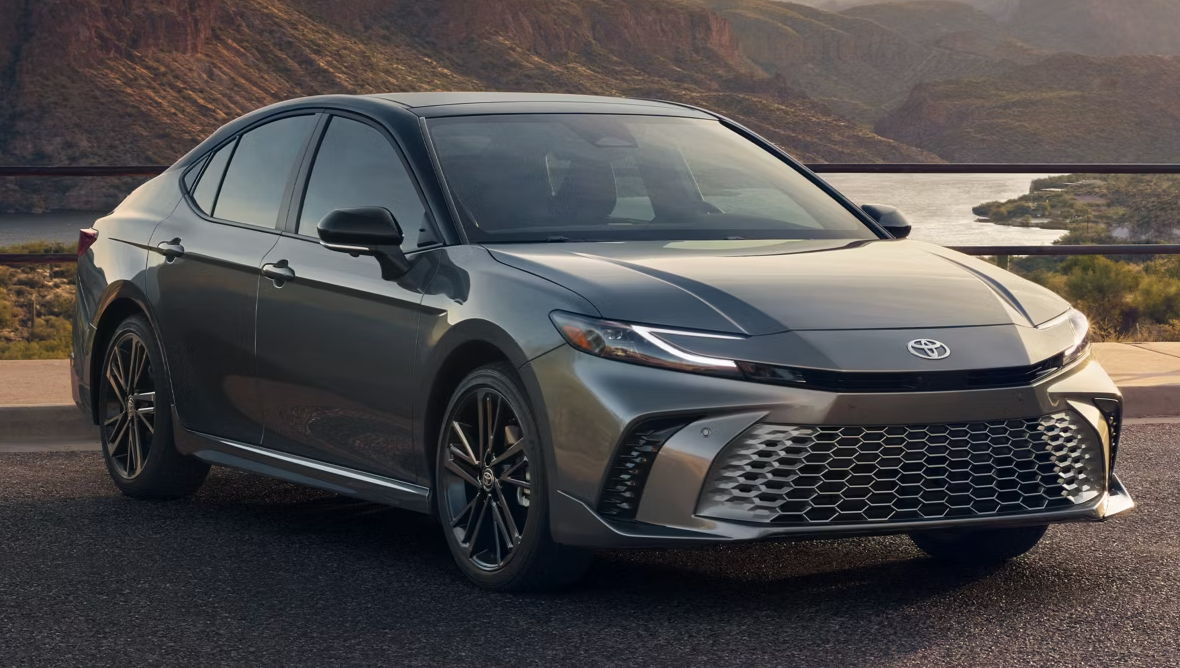
The 2025 Toyota Camry and the 2025 Nissan Altima stand at the top of the midsize sedan market. To help you get the best value and see which model is right for you, our team at Keith Pierson Toyota pits these sedans against each other to highlight their differences and advantages. Read this Nissan Altima and Toyota Camry comparison guide to dig into what matters: performance, features, and cost.
Engine Performance and Fuel Efficiency

When it comes to fuel economy, the Camry is the clear winner. The Altima tops out at just 27 mpg in the city and 39 mpg on the highway, while the Camry LE with front-wheel drive (FWD) hits 53 mpg city and 50 mpg highway, letting you go nearly twice as long between fill-ups. Even the sporty Camry XSE with all-wheel drive (AWD) delivers 44 mpg city and 43 mpg highway — nearly double most conventional sedans.
The Camry is also the more powerful model, with a hybrid system that packs 225 horsepower in FWD or 232 horsepower in AWD. The Altima’s 2.5-liter four-cylinder engine only outputs 188 horsepower in FWD or 182 horsepower in AWD. However, Nissan wins in acceleration, with 180 lb-ft of torque for FWD or 178 lb-ft for AWD, compared to the Camry’s 163 lb-ft.
Both cars offer AWD, perfect for when you need to maintain traction during sudden Florida downpours. The Altima’s quick acceleration is ideal for Jacksonville’s short on-ramps, but its traditional engine needs more time to build power than the Camry’s electric motor. The Camry’s system also transfers power between wheels automatically, which helps prevent hydroplaning on wet roads.
Interior Design and Comfort
While the Camry and the Altima have similar interior designs and comfort features, there are a couple of notable differences.
Cabin Features
Both sedans offer quality cabins built for Florida driving. The Altima features soft-touch surfaces, intuitive controls, and power-adjustable, heated Zero Gravity front seats that are perfect for chilly mornings and long drives to Orlando. The Camry’s SofTex upholstery is easy to clean after beach days, with sand, sunscreen, and spills wiping right off. Both cars use fade-resistant materials, which is crucial for Florida’s sunny weather.
Interior Dimensions
Cabin space differs between models. The Altima gives you 100.6 cubic feet of passenger space and 43.8 inches of front legroom — ideal if you’re a tall driver. The Camry is slightly less roomy overall, with 99.9 cubic feet of passenger space and 42.1 inches of front legroom. However, with 38 inches of legroom in the rear seats, the Camry is more comfortable for family trips with teenagers and adult passengers, as opposed to the Altima’s 35.2 inches.
Trunk space is virtually identical. The Altima’s 15.4 cubic feet of storage space barely edges out the Camry’s 15.1 cubic feet. Both can easily handle grocery trips and weekend gear.
Comfort and Aesthetics
Both cars have unique touches, such as the Altima’s 10-color ambient lighting and the Camry’s optional tinted panoramic sunroof. They also include several practical features, such as dual-zone climate control, USB ports, and sizeable cupholders. In particular, the Camry’s climate system adjusts quickly to fight windshield fogging, which is a small but crucial feature for Jacksonville’s humid weather.
Safety and Technology Features
Safety comes standard in both sedans. The Camry includes Toyota’s Safety Sense 3.0, while the Altima features Nissan’s Safety Shield 360. Both systems pack the essentials: forward collision warnings, automatic emergency braking, pedestrian detection, blind-spot monitoring, lane departure warning, and smart high beams. These features are more than marketing points — they provide actual peace of mind.
Technology
Both cars offer 8-inch or 12.3-inch touch screens that are visible even under Florida’s bright sun. The Camry includes wireless Apple CarPlay and Android Auto on all trims, while the Altima only offers it on higher-end models. Also, they both provide hands-free voice controls, letting you turn on your wipers and adjust climate controls without having to take your eyes off the road. All you have to do is say “Hey, Toyota” or “Hello, Nissan.”
The Camry features a 12.3-inch digital gauge cluster, wireless phone charging, and over-the-air updates, while the Altima gives you an anti-glare 9-inch windshield display and optional nine-speaker Bose audio system. Deciding which offering is best largely depends on your daily needs, but if you’re a tech lover, you won’t be disappointed either way.
Pricing, Value, and Reliability
The Altima starts at $27,000 MSRP for the base S trim, while the Camry’s base LE trim costs $28,700. But don’t just look at the sticker price. Consider the total ownership costs. The Camry’s more efficient hybrid system can save you up to $1,000 yearly on gas. Toyotas also hold their value better, with the Camry keeping 62% of its worth vs. the Altima’s 58%. That 4% difference matters at trade-in. Toyota’s warranty stands out too: Hybrid parts are covered for eight years or 100,000 miles, and batteries are protected for 10 years or 150,000 miles.
When comparing the Nissan Altima vs. the Toyota Camry for reliability, there’s a clear winner. U.S. News and World Report rated the Camry a 9.6/10 and the Nissan a 8.3/10, citing the Camry’s well-built interior and powerful engine. The Car Connection ranks the Camry as the third-best midsize car, noting its power and practicality, while the Altima sits at seventh place.
Which Is Better: The Toyota Camry or the Nissan Altima?
Deciding which sedan is the best fit for you mainly depends on your priorities, but with superior fuel economy, power, resale value, and reliability ratings, the 2025 Toyota Camry is hard to beat. If you’d like to see the Camry in person and try it out for yourself, visit us at Keith Pierson Toyota. Our expert team is here to help you find the perfect car for you, and we’d love to set you up for a test drive.
Dynamic Toyota Camry Driving on Erbil Highway by Harem is licensed with Pexels License
Connect with us


Recent Blog Entries
- Toyota Tundra for Sale in Jacksonville, FL: Your Guide to Trims and Features
- Bands from Jacksonville, FL: A Soundtrack for Your Next Toyota Road Trip
- 2026 Toyota Camry vs. 2026 Honda Accord: The Midsize Sedan Showdown in Jacksonville
- Top 5 Free Things To Do in Jacksonville This Summer: Explore with Keith Pierson Toyota
- Jacksonville’s Best Spring Events: Drive There in Comfort with Your Toyota