


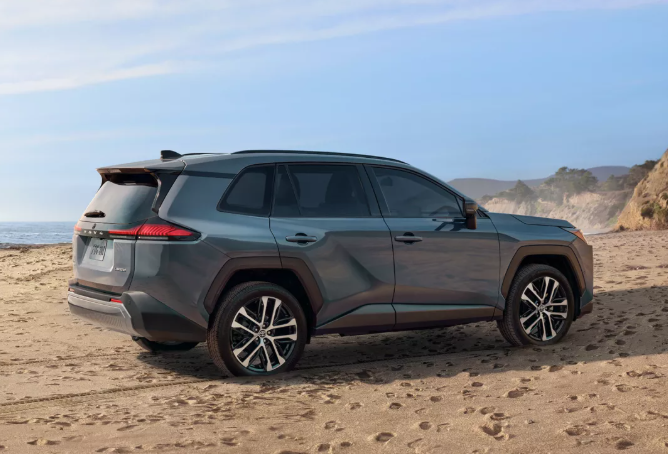
Jacksonville drivers weighing their options between compact SUVs often find themselves in the classic Toyota RAV4 vs. Honda CR-V debate. Families, young workers, and retirees in Northeast Florida are looking for something both affordable and reliable, and both vehicles have their merits. At Keith Pierson Toyota, we’ll explain why we believe the 2026 Toyota RAV4 is the option for drivers negotiating Florida’s coastal climate and weather fluctuations.
Performance and Hybrid Options
The 2026 Toyota RAV4 offers two electrified powertrains: a standard hybrid with a choice of front-wheel drive (FWD) or all-wheel drive (AWD) and a plug-in hybrid exclusively with AWD. Both versions feature a 2.5-liter Atkinson-cycle four-cylinder engine and two electric motors paired with an electric variable transmission. The hybrid FWD produces 226 horsepower, the hyrbid AWD 236 horsepower, and the plug-in hybrid AWD 320 horsepower. The RAV4’s maximum towing capacity is 3,500 pounds when properly equipped.
Honda’s 2026 CR-V offers both gas and hybrid powertrains. The hybrid pairs a 2.0-liter Atkinson-cycle four-cylinder with two electric motors and generates 204 horsepower, while the turbo 1.5-liter produces 190 horsepower, but neither matches the RAV4’s punch. The CR-V Hybrid comes standard with FWD, and AWD is optional but standard on higher trims. The CR-V’s 1500-pound maximum towing capacity makes it less than ideal for boating trips to Cedar Point.
EPA ratings are unavailable for 2026, but the new RAV4 hybrid has a manufacturer-estimated 44 mpg combined with FWD, and Toyota projects the plug-in hybrid to get up to 107 MPGe with an all-electric range of up to 52 miles. The 2026 CR-V achieves an EPA-estimated 40 mpg combined for FWD. Car and Driver’s real-time testing had the RAV4 AWD hybrid accelerating from 0 to 60 mph in 7.1 seconds, the plug-in hybrid in 5.2 seconds, and the Honda CR-V in 7.9 seconds.
Safety and Driver-Assistance Features
The National Highway Traffic Safety Administration has selected the 2026 RAV4 hybrid for testing on its advanced safety system. Toyota Safety Sense 4.0 is standard on the RAV4 and features advanced systems such as precollision with pedestrian detection, lane departure alerts, full-speed range dynamic radar cruise control, trailer sway control, and a blind-spot monitor. Whether you’re stuck downtown, cruising the highway, or adapting to changing weather conditions, these systems work together seamlessly.
Honda Sensing safety technology includes precollision with enhanced night vision, lane departure with steering correction, adaptive cruise control that functions in stop-and-go traffic, and sign assist. The CR-V also incorporates collision mitigation and road departure mitigation for extra safety. While both SUVs come equipped with strong safety technology, Toyota’s updated suite gives the RAV4 a slight edge.
Interior Space, Comfort, and Technology
The 2026 RAV4 features a new 12.3-inch digital cluster, along with a standard 10.9-inch touch screen or a 14.6-inch screen available on higher trims. Measuring 181 inches in length (182 inches for the Woodland), its 105-inch wheelbase ensures a smooth ride on Jacksonville’s roughest roads. Five passengers fit comfortably in the 98.9-cubic-foot passenger area, and the rear seats fold flat to give you a total of 70.4 cubic feet of cargo room.
In comparison, the CR-V Hybrid offers 103.5 cubic feet of passenger volume with 41.3 inches of front legroom and 40.4 inches in the back. It provides class-leading space for five passengers with a maximum cargo area of 76.5 cubic feet with the rear seats folded. Standard features on the CR-V include a 9-inch touch screen with Google built-in and wireless charging.
Value, Pricing, and Toyota Resale Strength
Honda’s lower starting MSRP price of $30,920 for the entry-level gas CR-V and $35,630 for the Sport Hybrid might tempt you. Toyota announced that the RAV4’s MSRP will start at $31,900 for the Hybrid FWD model. The RAV4 Plug-in Hybrid pricing will be available in early 2026, but it’s expected to start in the high $40,000 range. Toyota’s lineup of electric vehicles provides eco-conscious drivers with an opportunity to find an SUV that meets both their budget and needs. Consider contacting our finance department to explore your financing options.
Both hybrid SUVs come with three-year/36,000-mile basic and eight-year/100,000-mile hybrid component warranties, although Toyota adds a 10-year/150,000-mile battery warranty. Gas CR-Vs come with a three-year/36,000-mile limited warranty and a five-year/60,000-mile powertrain warranty, free maintenance for one year/12,000 miles, and three years of roadside assistance.
Toyota’s excellent resale value and reliability make the RAV4 the smarter long-term investment for Jacksonville drivers. According to Kelly Blue Book valuations, a 2020 RAV4 typically has a resale value of $18,459, with a trade-in value of $16,367 depending on condition.
Final Verdict for Jacksonville Drivers
In this 2026 RAV4 comparison, both SUVs offer strong options. For us, the RAV4’s Dynamic Torque Vectoring AWD grips roads better, especially the Woodland Edition, which easily manages beach trips, Florida’s downpours, and rugged camping spots. The CR-V’s AWD is adequate for light rain and sandy roads but lacks muscle for true off-roading or storm flooding.
Experience the 2026 RAV4 at Keith Pierson Toyota
At Keith Pierson Toyota, we’ve built a reputation in Jacksonville, and when you combine Toyota’s bulletproof quality with our customer-first approach, you get the ideal place to find your perfect 2026 RAV4. If you’re ready to see why the best compact SUV in 2026 is the RAV4, visit our Jacksonville dealership to see our 2026 lineup or contact us to book a test-drive. Our team understands Florida’s driving conditions and is happy to answer questions from fuel economy to leasing options.
Connect with us


Recent Blog Entries
- 2026 Toyota Tundra 1794 Edition Overview
- 2026 Toyota RAV4 vs. 2026 Honda CR-V: Why the RAV4 Wins for Jacksonville Drivers
- 2026 Toyota Tundra vs. 2026 Ford F-150: Which Full-Size Truck Dominates?
- What’s New for the 2026 Toyota Tundra? A Complete Guide for Jacksonville Truck Shoppers
- What’s New for the 2026 Toyota Camry — A Fresh Take on a Legendary Sedan