

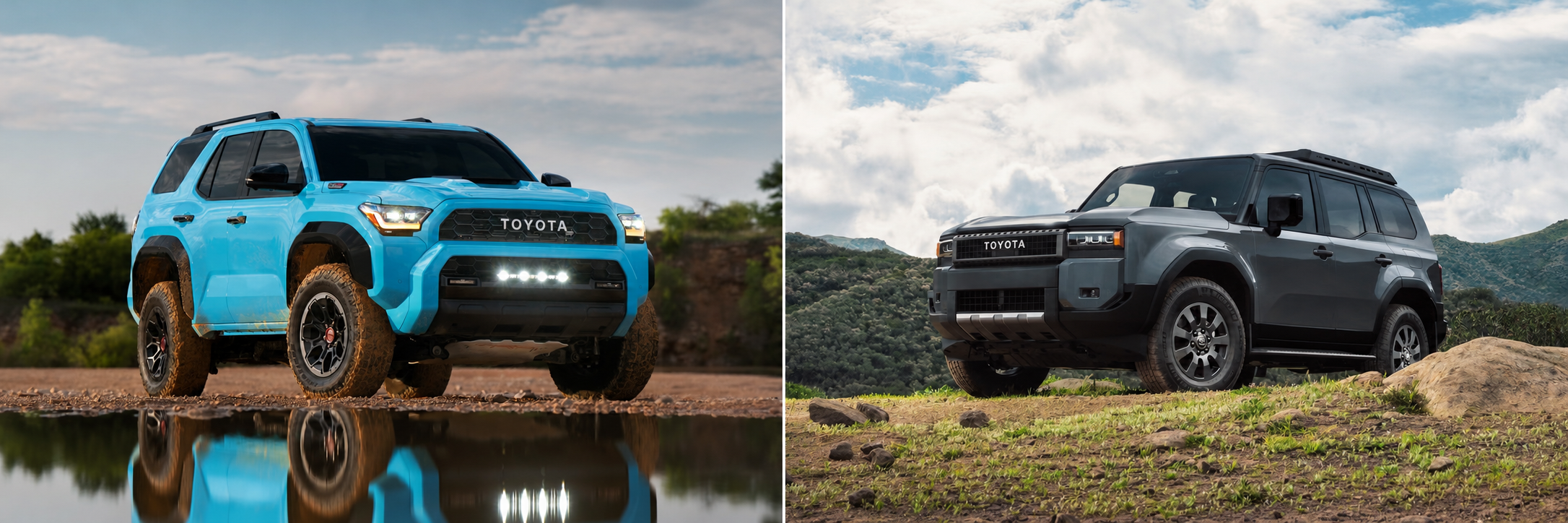
Choosing between the 2026 Toyota 4Runner and Land Cruiser comes down to how you live and play around Jacksonville. Both are body-on-frame SUVs with real adventure credentials, but they're built around different ideas. This guide covers the specs that matter for I-95 commuting, boat ramps and weekend trips, so you can decide by your own priorities.
2026 Toyota 4Runner vs. Land Cruiser: Quick Overview for Jacksonville Drivers
The 4Runner offers range, while the Land Cruiser offers consistency. The 2026 Toyota 4Runner spans nine trims and two powertrains, while the 2026 Toyota Land Cruiser comes in two grades, both hybrid with full-time 4WD. The table below uses Toyota's 2026 specifications and EPA estimates.
| Model/Trim | Powertrain | Horsepower/Torque | Drivetrain | Fuel Economy (City/Hwy/Combined) | Seating/Cargo |
|---|---|---|---|---|---|
| 4Runner SR5, TRD Sport, TRD Sport Premium | i-FORCE 2.4L turbo four-cylinder, standard, eight-speed automatic | 278 hp/317 lb.-ft. | RWD or 4WD | RWD 20/26/22. 4WD 19/25/21 | Seats five. Third row (up to seven) available on i-FORCE SR5. Two-row 90.2 cu ft behind front row, 48.4 behind second. Three-row 84.1/44.8/12.1 behind third |
| 4Runner TRD Off-Road, TRD Off-Road Premium, Limited | i-FORCE MAX 2.4L turbo hybrid available, eight-speed automatic | i-FORCE MAX: 326 hp/465 lb.-ft. | 4WD. Limited full-time 4WD available on i-FORCE MAX | TRD Off-Road and Premium 4WD 19/25/21. Hybrid 4WD 23/24/23. Limited RWD 20/24/22, 4WD 20/24/21, Hybrid 4WD 23/24/23 | Seats five. Third row available on Limited i-FORCE. i-FORCE MAX 82.6 cu ft behind front row, 42.6 behind second |
| 4Runner TRD Pro, Trailhunter, Platinum | i-FORCE MAX, standard, eight-speed automatic | 326 hp/465 lb.-ft. | 4WD. Platinum full-time 4WD with electronic locking center differential | 23/24/23 | Seats five. 82.6 cu ft behind front row, 42.6 behind second |
| Land Cruiser 1958 and Land Cruiser | i-FORCE MAX hybrid, standard on both grades, eight-speed automatic | 326 hp/465 lb.-ft. | Standard full-time 4WD | 22/25/23 (EPA-estimated) | Seats five. 82.2 cu ft behind first row, 46.2 behind second |
Powertrain Approach: Turbo Four-Cylinder and Hybrid Options Compared
Toyota gives the 4Runner two choices, while the Land Cruiser has one. That decision affects fuel economy, and it also changes how a ramp onto I-295 feels.
Standard vs. Available Powertrains and Performance
The i-FORCE MAX hybrid is standard on the 4Runner TRD Pro, Trailhunter and Platinum, available on the TRD Off-Road, TRD Off-Road Premium and Limited, and standard on both Land Cruiser grades. The non-hybrid i-FORCE is standard on the SR5, TRD Sport and TRD Sport Premium. So match the powertrain first when you compare, since a non-hybrid 4Runner against a hybrid Land Cruiser is a different comparison than two hybrids. The hybrid's extra 148 lb-ft of torque helps most when merging, towing or carrying a full load.
Fuel Economy and Daily Driving Feel
In combined mpg, the hybrids are a near-match. The Land Cruiser and every hybrid 4Runner rate 23 mpg combined, while the non-hybrid 4Runner ranges from 21 to 22. Real mileage will shift with towing, traffic, tires and driving habits.
Ride character differs by trim, from the 4Runner TRD Sport's sport-tuned suspension to the adaptive setups on the Limited and Platinum. A test drive on your own commute tells you more than any spec sheet.
Seating, Cargo Space and Everyday Practicality
Spec sheets can't tell you whether a cabin fits your family, but dimensions help narrow it down.
Seating Layouts and Cargo Flexibility
Both SUVs seat five in standard form. The 4Runner adds an available fold-flat third row (up to seven) on i-FORCE SR5 and Limited configurations only. Using that row shrinks luggage space to 12.1 cu ft behind it, so it's a trade-off. Land Cruiser legroom runs 43.0 inches front and 36.7 rear, compared with 41.8 and 34.8 for the 4Runner. Taller drivers should sit in both, since headroom and posture are personal.
Size, Parking and Family Use
In dimensions, the two are nearly identical. Both share a 112.2-inch wheelbase, and the 4Runner is 194.9 inches long against 193.8 for the Land Cruiser. Width is 77.9 inches on the Land Cruiser and most 4Runner trims, widening to 79.9 inches on the TRD Pro and Trailhunter. Turning radius is 19.7 feet for the 4Runner and 20 feet for the Land Cruiser.
In tight Riverside or downtown parking, the differences are small. Check child-seat access, garage fit, and visibility in person.
Towing Capability and Four-Wheel-Drive Technology
A boat in summer heat tests a drivetrain differently than a dry trail does. Each SUV handles it a little differently.
Towing Ratings and What They Mean for Boats and Trailers
Maximum towing is 6,000 lb on both the 4Runner and the Land Cruiser, so neither has an edge there. A tow rating is the most a properly equipped vehicle may pull, and it can vary by trim and configuration. Tongue weight is the downward force the trailer puts on the hitch, and it counts against payload. So do passengers and a full cooler. Staying under the tow rating isn't enough if you exceed payload, so confirm limits for the exact vehicle.
Equipment helps with a bay boat. A trailer brake controller comes standard on both Land Cruiser grades. On the 4Runner, you can add one, along with Trailer Back-Up Guide with Straight Path Assist. Blind Spot Monitor extends detection to a trailer, and Trailer Merge Warning is standard across 4Runner grades.
Four-Wheel-Drive Systems, Locking Differentials and Available Off-Road Tech
The 4Runner comes in RWD, part-time 4WD, and full-time 4WD. All i-FORCE MAX models have 4WD, Limited full-time 4WD is available on i-FORCE MAX, and Platinum has full-time 4WD with an electronic locking center differential. The 4Runner's locking rear differential is standard on TRD Off-Road, TRD Pro, and Trailhunter.
Both Land Cruiser grades come with full-time 4WD and a two-speed transfer case. Center and rear locking differentials are standard too. Full-time 4WD isn't the same as all-wheel drive, and a center lock and a rear lock do different jobs. Four-wheel drive adds traction but doesn't make a slippery ramp risk-free.
Off-Road Features, Beach Access and Outdoor Recreation
A rugged look doesn't prove capability. Drivetrain and tires matter, as do suspension, protection, and traction tech, and many are trim-specific.
Off-Road-Oriented Trims and Features: Standard vs. Available
On the 4Runner, TRD Off-Road adds underbody protection, 18-inch wheels, 33-inch all-terrain tires, and Bilstein shocks. TRD Pro has TRD-tuned FOX shocks. Trailhunter brings Old Man Emu shocks, an onboard air compressor, a roof rack, and high-strength underbody protection. Multi-Terrain Select (mud, dirt, sand) and Crawl Control are standard on TRD Off-Road, TRD Off-Road Premium, TRD Pro, and Trailhunter. Stabilizer disconnect is standard on TRD Pro and Trailhunter, and optional on i-FORCE MAX TRD Off-Road Premium.
On the Land Cruiser, Crawl Control is standard on both grades, and the Land Cruiser grade adds Multi-Terrain Select (Mud, Dirt, Sand), an enhanced Multi-Terrain Monitor and Rigid color-selectable LED fog lights. Both grades come standard with a front skid plate protecting the engine, transmission and transfer case, plus front and rear frame-mounted tow hooks. Stabilizer disconnect is available.
Ground clearance is 8.7 inches on both Land Cruiser grades. On the 4Runner, it ranges from 8.1 inches (SR5) and 8.8 (TRD Sport, Limited, Platinum) to 9.1 (TRD Off-Road and TRD Off-Road Premium) and 10.1 (TRD Pro, Trailhunter). Approach, departure and breakover angles are 33/24/24 degrees on the 4Runner TRD Pro and Trailhunter and 32/22/23 on the Land Cruiser.
Real-World Fit for Florida Trails, Dirt Roads, Beaches and Boat Ramps
Florida terrain is mostly soft sand and muddy access roads, plus wet launches. Think Black Creek trails, Guana River approaches, or a St. Johns River boat ramp with kayaks on the roof. Here, traction and low-speed control matter more than extreme angles.
Beach driving rules differ by county and beach, including in Duval and St. Johns counties, so check current local regulations before heading out. After salt and sand, rinse and inspect your vehicle, and our service team can help with upkeep for towing and off-road use.
Want to talk through your terrain? Contact us and we'll help you compare trims.
Daily Comfort, Road-Trip Use and Technology
Most miles are on pavement, so comfort and tech deserve as much attention as off-road gear.
Ride Comfort, Cabin Design and Long-Distance Travel
Trim changes comfort as much as model does. 4Runner front seats are heated and ventilated on TRD Sport Premium, TRD Off-Road Premium, Limited, Platinum, TRD Pro, and Trailhunter. Dual-zone climate control is standard on Limited, Platinum, TRD Pro, and Trailhunter. Platinum adds heated, reclining, tumble second-row seats.
The Land Cruiser 1958 has heated front seats, and the Land Cruiser grade has heated and ventilated front seats, with three-zone climate control on both. The Land Cruiser grade's available Premium Package adds a leather-trimmed memory power driver's seat, a power moonroof, a 14-speaker JBL system, a digital rearview mirror, a head-up display and wireless charging. Standard 2400W AC power comes on i-FORCE MAX 4Runners and both Land Cruiser grades. For a 4Runner Limited vs Land Cruiser comparison, check cabin noise and seat support on a run to St. Augustine or Amelia Island.
Infotainment, Driver-Assist and Safety Features
The 4Runner SR5, TRD Sport and TRD Off-Road have an 8-inch display, while the TRD Sport Premium, TRD Off-Road Premium, Limited, Platinum, TRD Pro and Trailhunter get a 14-inch display with a 14-speaker JBL system. Wireless Apple CarPlay and Android Auto are included. The Land Cruiser 1958 has an 8-inch touchscreen and six speakers, and the Land Cruiser grade has a 12.3-inch touchscreen and 10 speakers. A 12.3-inch screen with 14-speaker JBL audio is available on both Land Cruiser grades.
Toyota Safety Sense 3.0 is standard on every grade of both, including Pre-Collision System with Pedestrian Detection, Lane Departure Alert with Steering Assist, Full-Speed Range Dynamic Radar Cruise Control, Lane Tracing Assist, Road Sign Assist, Automatic High Beams and Proactive Driving Assist. Every 4Runner also gets Blind Spot Monitor with Rear Cross-Traffic Alert, Front Cross-Traffic Alert and Traffic Jam Assist as standard. On the Land Cruiser, Front Cross-Traffic Alert and Traffic Jam Assist come with the Land Cruiser grade's Premium Package. These systems support an attentive driver, who stays responsible for the road.
Matching Each SUV to Your Buyer Priorities
Start with what you do most often, then compare the spec that serves it.
Towing a boat: Both max out at 6,000 lb, so compare tongue weight, payload, and the trailer brake controller (standard on Land Cruiser, available on 4Runner).
Daily commuting: Compare fuel economy for the exact trim and test drive both on I-95.
Family hauling: Check whether you need the 4Runner's available third row or prefer the Land Cruiser's rear legroom.
Trail frequency: Compare TRD Off-Road, TRD Pro, or Trailhunter equipment with the Land Cruiser's standard locking differentials.
When the 4Runner May Fit
The 4Runner may fit if you want to pick your own configuration, need an available third row or prefer a non-hybrid i-FORCE option. Specialized trims like the Trailhunter, with its onboard air compressor and roof rack, add another draw, and every 4Runner includes Front Cross-Traffic Alert and Traffic Jam Assist as standard.
When the Land Cruiser May Fit
The Land Cruiser may fit if you want the hybrid powertrain, full-time 4WD, and locking differentials on every grade without selecting them separately. Some shoppers also simply prefer its upright design and rear legroom. Whichever you choose, budget for fuel and insurance, and for maintenance on top of the purchase price.
Compare Toyota SUVs at Keith Pierson Toyota
Explore Current Toyota SUV Inventory and Schedule Test Drives
Toyota SUV demand can limit availability, so ask us about current and incoming inventory. We're a family-owned Toyota dealership in Jacksonville, FL, selling new and used vehicles with service, parts, and financing. This 2026 Toyota SUV comparison is easiest to finish in person.
Drive both on city streets and highways, and try tight parking spots with your regular passengers. If you plan to tow, bring your trailer details so we can help you confirm limits. Ready to start? Explore our new Toyota inventory or get pre-approved.
Contact Our Team
Call our sales team at 888-461-3879 or visit us at 6501 Youngerman Circle in Jacksonville, and we'll help you compare the 4Runner and Land Cruiser side by side.